
- AI holds the promise of quicker decision-making, smarter work, and massive productivity increases. However, in reality, most organizations find themselves stuck somewhere between expectations and execution. With finding the expertise, navigating the complexity of data, dealing with integration issues, security issues, and budgets, teams spend more time considering how to overcome problems rather than focusing on the value of AI adoption real time. It is frustrating when we can see the potential, but do not know how to proceed.
- So how do companies knock down on-the-ground barriers and adopt AI without losing direction or consuming resources? If you have this in mind, the content here is for you. Read on to learn how you can take next steps in AI adoption, focus on mobility, and create genuine innovation to deliver business impact.
Key Takeaways
- AI presents huge possibilities for efficiency, decision-making, and business growth – but you need strategic planning to truly harness those possibilities, not just an investment in technology.
- The leading barriers to adoption are data readiness, lack of skilled resources, integration issues, uncertainty about security, and unclear expectations for ROI.
- Organizations that piloted smaller projects with clear use cases instead of trying to implement AI all at once, have achieved a much greater level of success.
- It is important for there to be collaboration across the leadership, IT, and operational teams, so everyone is aligned on the goals and AI contributes to business value.
- Organizational roadblocks and scaling AI can be overcome through a defined roadmap including training, change management, and ongoing monitoring.
Why AI Adoption Is Challenging —
A Strategic Overview
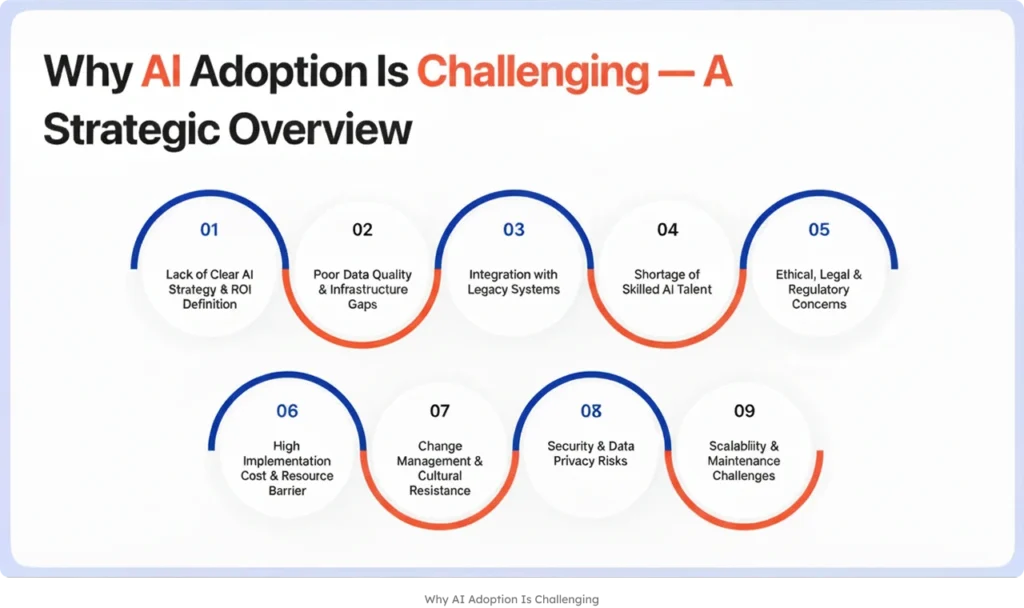
While organizations are aware of the potential benefits that AI brings, the Top Challenges in AI Adoption often complicate the journey. True AI adoption is not as simple as buying expensive tools or plugging in automation; there is an aspect of alignment that must happen that goes across data, people, processes, and long-term strategies. That is often where organizations stop short of full realization. AI will improve efficiency, productivity, and speed up decision-making; you still have to figure out how to get it done and deliver on that ambition.
It should be clear by now that AI adoption is hard due to the need for operational readiness combined with cultural readiness. Many teams may want to innovate, but don’t have clean data, trained AI talent, adaptable infrastructure, or an organization that understands how AI fits in context. And when one or more of those particular fundamentals is missing, companies iterate forever without measurable impact and progress toward intended outcomes, wasting time, effort and resources, leading to frustration.
Struggles to integrate with legacy systems, infrastructure challenges
Low quality, unstructured data, or simply not enough data to train their AI
Limited internal skillsets related to AI, or dedicated resources to manage ai projects
Struggles to integrate with legacy systems, infrastructure challenges
- Low quality, unstructured data, or simply not enough data to train their AI
- Limited internal skillsets related to AI, or dedicated resources to manage ai projects
- Struggles to integrate with legacy systems, infrastructure challenges
- High upfront costs and unclear ROI forecasts
- Security, privacy, and compliance have stopped companies from deploying AI and staying compliant
Top Challenges in AI Adoption
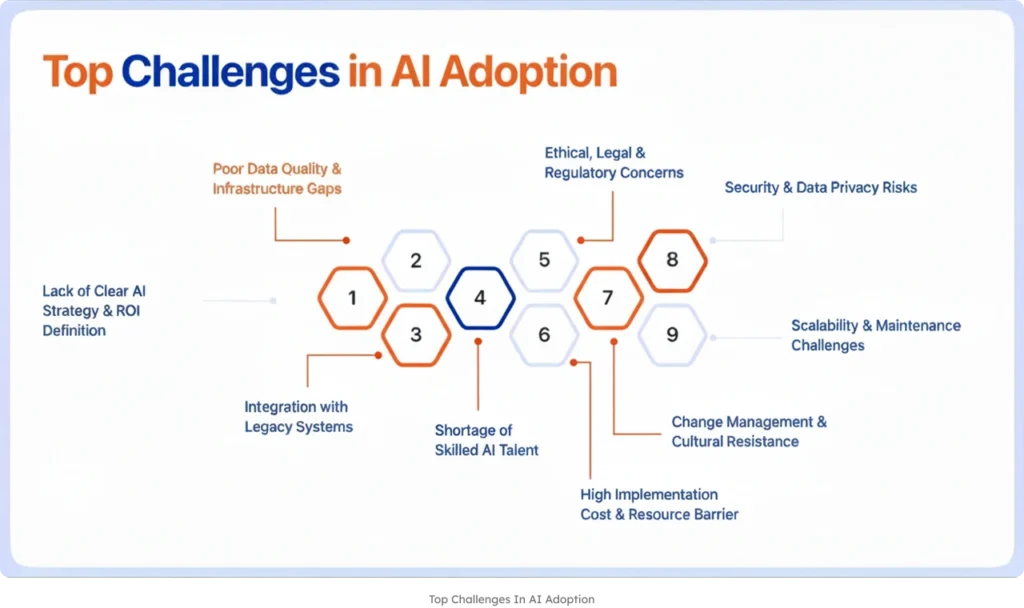
Lack of Clear AI Strategy & ROI Definition
A clear metric for success and a clear actionable AI strategy is one of the Top Challenges in AI Adoption. Many companies begin the journey of digital transformation not having a clear understanding of their goals, KPI and ROI the organization is expecting. Without explicit definition of the business value to be derived by an AI strategy, organizations struggle to select use cases that are meaningful and how to justify the spend for investment in. The AI project feels experimental vice-value based-which causes confusion of teams, wasted budget and misalignment of stakeholders. A roadmap allows organizations to evaluate the value from AI in the context of revenue, efficiency and customer experience.
Poor Data Quality & Infrastructure Gaps
AI systems require structured, consistent and usable data, but poor quality data is one of the biggest changes in AI implementations. Inconsistency, incomplete, silo-ed or simply unclean data prevents any semblance of accurate insights or the ability to train models usefully. The firm typically faces infrastructure limitations to achieve the promise and value of AI when legacy databases, on-premise systems and ancient tools cannot support advanced analytics or automation. Critical factors will be data readiness, modern data pipelines, cloud architecture and the ability to unlock the success of AI and improve the ability to make informed decisions across the organization.
Integration with Legacy Systems
Another significant challenge in AI Adoption is integration with outdated legacy systems. Older systems are frequently not compatible with modern AI technologies, APIs, and cloud-based tools. Such incompatibility will result in delays, high integration efforts, and possible workflow disruptions. Often, companies have concerns about undue downtime, operational risk, or both when trying to integrate AI with legacy systems. Companies often also hesitate or battle with the thought of executing AI deployments during all this. Revamping tech architecture, adopting microservices for integration, and creating hybrid cloud solutions can make integration more seamless and faster, accelerating digital transformation in organizations without disruption to existing operations.
Shortage of Skilled AI Talent
AI adoption and usage depends on specialized skillsets, which include data scientists, ML engineers, prompt engineers, AI product managers, and MLOps architects. As with many AI-related challenges, the global talent shortage for AI specialists has made hiring one of the greatest barriers in successfully executing AI projects. Many companies think trial and error is the only short term solution even though there are too many burdens being placed on their internal IT team, who are not typically AI specialists. Collaborating with an experienced vendor, replacing trial and error methodologies with upskilling, and outsourcing are some productive mechanisms companies can pursue to rapidly deploy higher levels of innovation without compromising on quality or timelines.
Ethical, Legal & Regulatory Concerns
AI delivers incredible potential, but concerns surrounding ethics and compliance add to the Top Challenges in AI Adoption. While there are legal implications regarding AI technology, companies find themselves worried about GDPR compliance, limitations on data usage, obligations around transparency, and whatever else may add to their hesitations about deploying our AI technology. Businesses may have concerns relating to algorithms containing bias, unfair decision-making, mistrust from their customers, and ethical priorities. Building transparent, accountable, and fair practices into our “responsible AI” position including transparency, bias mitigation, auditability, and ethics provides an opportunity to replace concerns with trust, while also adhering to industry regulations.
High Implementation Cost & Resource Barrier
AI is expensive due to newly acquired implementation and AI app development costs (associated costs may mount quickly when a company trains and deploys AI technology without a well-thought-out plan). Initially the licensing fees combined with storage needs, cloud usage, hardware upgrades, and personnel will mount costs. Very quickly the cost of financial commitments will bump into being one of the Top Challenges in AI Adoption. Many companies spend a lot of money due to unrealistic expectations paired with very visible technology developments but without forthright phased implementations. A pilot approach, prioritizing use cases, and utilizing pay-as-you-go cloud costs will reduce costs while still providing the opportunity for companies to get some return on their investment.
Change Management & Cultural Resistance
When the technology is available, people may not yet be ready to implement it. Employees often are concerned automation and AI will take jobs away from employees. Once the technology is implemented, employees will fight to have it adopted. Poor communication, lack of training, and poor involvement of employees can stall the entire digital transformation journey. Cultural resistance is one of the most overlooked challenges organizations face to enable AI. Organizations must educate teams, provide educational opportunities to users early in the implementation, and be clear that AI is a productivity tool and not a replacement, all of which foster a smoother, more efficient adoption and user acceptance.
Security & Data Privacy Risks
AI systems rely heavily on sensitive and private data, which is the cause of the security and privacy focus. Breaches, unauthorized access, model tampering, and personal data misuse are concerns and issues mentioned in the Top Challenges in AI Adoption and digital transformation. With increased functionality, the use of AI means integration with a number of platforms increases the attack surface. Without appropriate data encryption, access controls, and organizational compliance, organizations open themselves up to legal liabilities and penalties for reputational damage. To support the strong priorities of security and privacy, organizations need to implement a strong framework, secure data architectures, and continuous monitoring.
Scalability & Maintenance Challenges
Utilizing AI is only the first step and scaling it for long-term value is an altogether different effort. There are numerous organizations that have built impressive pilot projects only to fail to scale them across departments or to maintain accuracy over time. Scalability is a challenging aspect of successful AI implementation because of model drift, infrastructure and compute demands, increased data volume, and the inevitable need to update a model over time. Building MLOps frameworks, automation pipelines, and performance dashboards allow organizations to scale AI with confidence while ensuring models remain effective in a dynamic organization.
How You Can Overcome Of These
Top AI Challenges
Lack of Clear AI Strategy & ROI Definition
A clear metric for success and a clear actionable AI strategy is one of the Top Challenges in AI Adoption. Many companies begin the journey of digital transformation not having a clear understanding of their goals, KPI and ROI the organization is expecting. Without explicit definition of the business value to be derived by an AI strategy, organizations struggle to select use cases that are meaningful and how to justify the spend for investment in. The AI project feels experimental vice-value based-which causes confusion of teams, wasted budget and misalignment of stakeholders. A roadmap allows organizations to evaluate the value from AI in the context of revenue, efficiency and customer experience.
Poor Data Quality & Infrastructure Gaps
AI systems require structured, consistent and usable data, but poor quality data is one of the biggest changes in AI implementations. Inconsistency, incomplete, silo-ed or simply unclean data prevents any semblance of accurate insights or the ability to train models usefully. The firm typically faces infrastructure limitations to achieve the promise and value of AI when legacy databases, on-premise systems and ancient tools cannot support advanced analytics or automation. Critical factors will be data readiness, modern data pipelines, cloud architecture and the ability to unlock the success of AI and improve the ability to make informed decisions across the organization.
Integration with Legacy Systems
Another significant challenge in AI Adoption is integration with outdated legacy systems. Older systems are frequently not compatible with modern AI technologies, APIs, and cloud-based tools. Such incompatibility will result in delays, high integration efforts, and possible workflow disruptions. Often, companies have concerns about undue downtime, operational risk, or both when trying to integrate AI with legacy systems. Companies often also hesitate or battle with the thought of executing AI deployments during all this. Revamping tech architecture, adopting microservices for integration, and creating hybrid cloud solutions can make integration more seamless and faster, accelerating digital transformation in organizations without disruption to existing operations.
Shortage of Skilled AI Talent
AI adoption and usage depends on specialized skillsets, which include data scientists, ML engineers, prompt engineers, AI product managers, and MLOps architects. As with many AI-related challenges, the global talent shortage for AI specialists has made hiring one of the greatest barriers in successfully executing AI projects. Many companies think trial and error is the only short term solution even though there are too many burdens being placed on their internal IT team, who are not typically AI specialists. Collaborating with an experienced vendor, replacing trial and error methodologies with upskilling, and outsourcing are some productive mechanisms companies can pursue to rapidly deploy higher levels of innovation without compromising on quality or timelines.
Ethical, Legal & Regulatory Concerns
AI delivers incredible potential, but concerns surrounding ethics and compliance add to the Top Challenges in AI Adoption. While there are legal implications regarding AI technology, companies find themselves worried about GDPR compliance, limitations on data usage, obligations around transparency, and whatever else may add to their hesitations about deploying our AI technology. Businesses may have concerns relating to algorithms containing bias, unfair decision-making, mistrust from their customers, and ethical priorities. Building transparent, accountable, and fair practices into our “responsible AI” position including transparency, bias mitigation, auditability, and ethics provides an opportunity to replace concerns with trust, while also adhering to industry regulations.
High Implementation Cost & Resource Barrier
AI is expensive due to newly acquired implementation and AI app development costs (associated costs may mount quickly when a company trains and deploys AI technology without a well-thought-out plan). Initially the licensing fees combined with storage needs, cloud usage, hardware upgrades, and personnel will mount costs. Very quickly the cost of financial commitments will bump into being one of the Top Challenges in AI Adoption. Many companies spend a lot of money due to unrealistic expectations paired with very visible technology developments but without forthright phased implementations. A pilot approach, prioritizing use cases, and utilizing pay-as-you-go cloud costs will reduce costs while still providing the opportunity for companies to get some return on their investment.
Implement MLOps for Long-Term Scalability
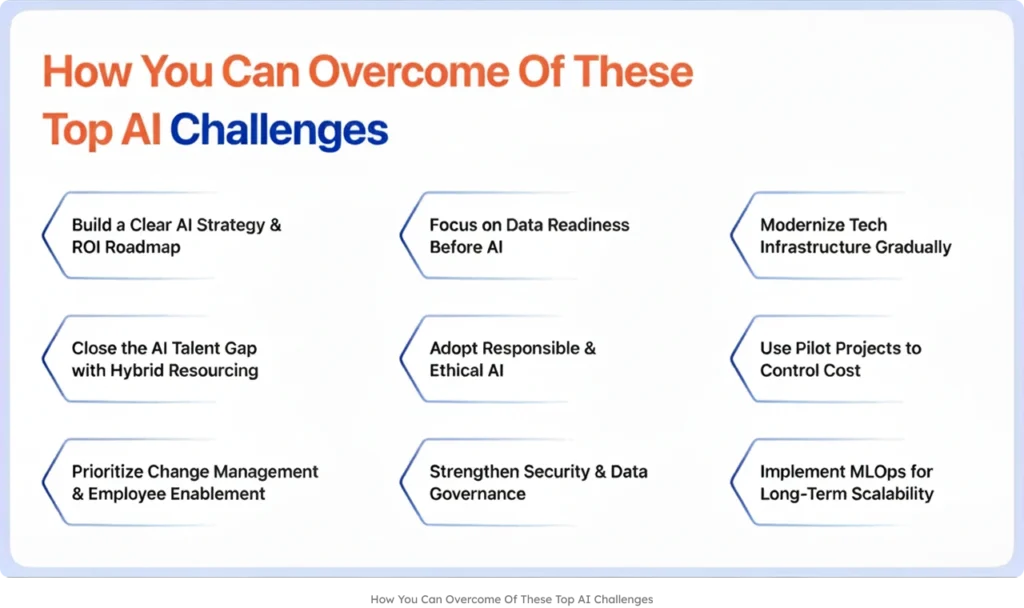
To successfully undertake this journey, you must first shift your way of thinking and the way that you approach the process of AI adoption to one that enables responsible, trustworthy, and ethical AI solutions to be implemented strategically in line with company objectives. When organizations implement responsible frameworks and empower teams, create transparency, and support collaboration across their business units they open up their opportunities to take a sustainable, scalable and responsible approach to AI adoption that can continue to grow as more sophisticated technology becomes available. Every organization has the capability to develop into an AI-enabled enterprise. With an emphasis on collaboration, governance and innovation and the continual improvement of AI systems, companies can realize the benefits of integrating AI as a business enabler and to improve their competitive advantage by utilizing AI to enhance the work performed by those within the organization and the customer experience outside of it.
AI Adoption – Overcoming the Top Challenges in AI Adoption requires shifting from a hype-driven approach to one that is based upon business objectives, data stewardship, and readiness within the organization.